
Ecommerce Growth Exposes the Limits of Manual Operations
Ecommerce brands rarely struggle because they lack activity. They struggle because activity becomes increasingly difficult to coordinate. As orders increase, customer questions multiply, fulfillment details become more complex, inventory signals move faster, and the owner or team is forced to make decisions from information scattered across too many systems.
At the early stage, manual effort can disguise operational weakness. A founder can answer every email, check every order, review every spreadsheet, and personally catch issues before customers notice. But that approach does not scale cleanly. As transaction volume rises, the business eventually reaches a point where effort alone is no longer enough. The brand needs operational intelligence, not just more labor.
This is where smarter automation becomes essential. It is not simply a way to save time. It is a way to protect quality, improve responsiveness, and give the business a more reliable operating layer behind the customer-facing experience.
The Deeper Issue Is Operational Fragmentation
Most ecommerce brands do not operate from one clean system. They operate from a collection of disconnected tools: storefront platforms, payment processors, shipping dashboards, inboxes, spreadsheets, inventory systems, ad platforms, customer support channels, review platforms, and social messages. Each tool may serve a purpose, but the fragmentation creates friction.
The problem is not that information does not exist. The problem is that the information is often delayed, buried, duplicated, or disconnected from the next decision. A low-stock product may be visible in one system but not connected to a reorder process. A customer complaint may sit in an inbox without being tied to an order issue. A pattern in returns may exist, but no one sees it until it becomes expensive.
In ecommerce, these small disconnects compound quickly. They slow down decision-making, weaken customer communication, and make the business more reactive than strategic.
Basic Automation Moves Tasks. Smarter Automation Interprets Signals.
Traditional automation is useful, but limited. It can send a confirmation email, update a record, or move data from one app to another. These functions matter, but they are not enough for brands operating in a more complex digital environment.
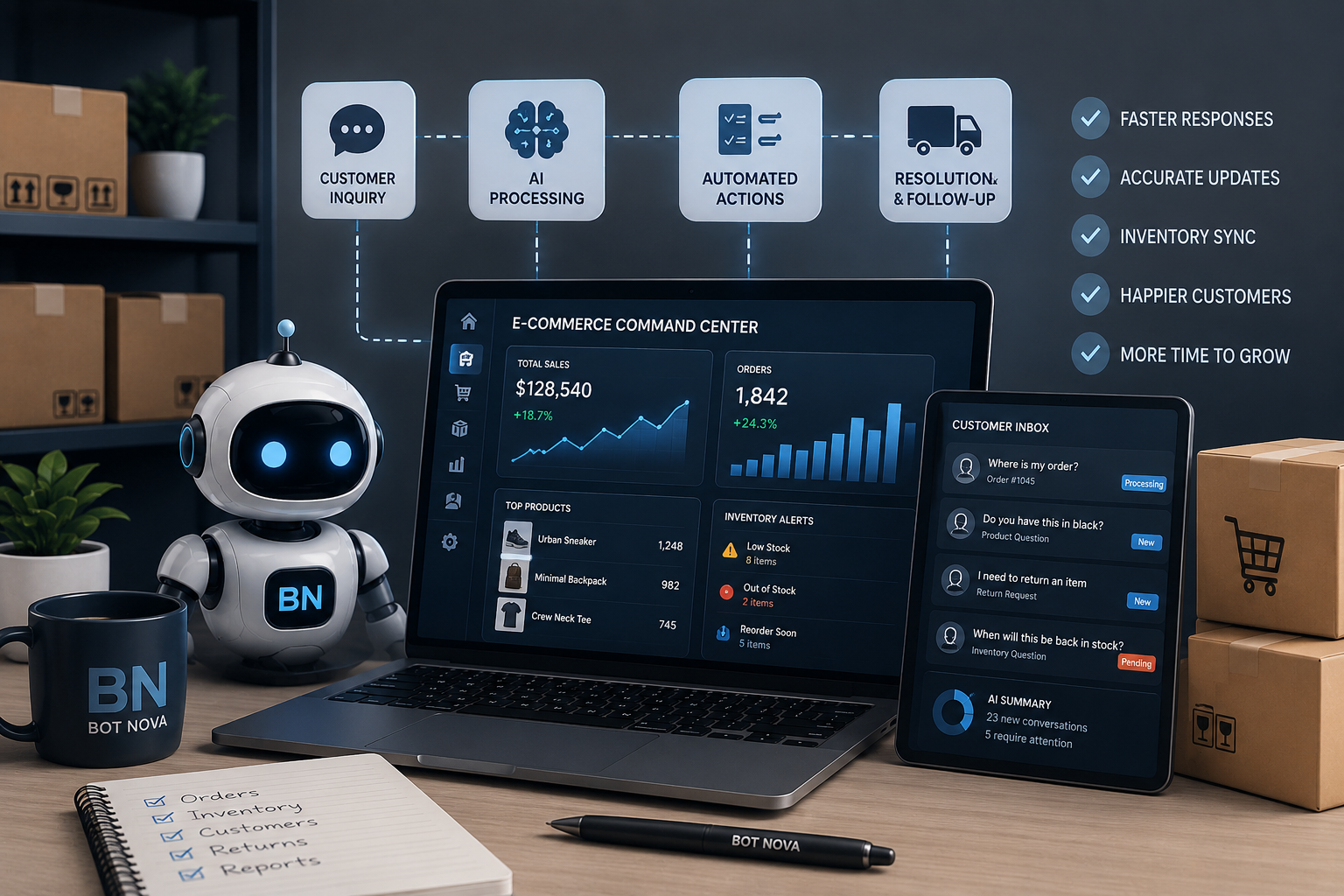
Smarter automation adds context. It can classify a customer request, summarize order history, flag unusual activity, prioritize support issues, identify inventory concerns, and prepare the next action for review. Instead of simply moving information, it helps interpret what the information means.
That distinction is important. Ecommerce brands do not just need faster task completion. They need faster awareness. They need systems that surface the right issue before it becomes a customer experience problem.
Customer Experience Depends on Backend Discipline
Customers rarely see the backend of an ecommerce business, but they experience its quality. They feel it when a support reply is timely and accurate. They feel it when order updates are clear. They feel it when a return is handled without confusion. They feel it when a brand remembers context instead of forcing them to explain the same problem multiple times.
Strong customer experience is not only a matter of branding, design, or tone. It is also a matter of operational discipline. If customer information is scattered, if messages are not triaged, if fulfillment exceptions are not flagged, or if teams are working from incomplete context, the customer experience eventually suffers.
Smarter automation helps protect that experience by organizing the backend around speed, consistency, and visibility. It gives teams a better chance to respond with precision instead of reacting from a crowded inbox.
Where Ecommerce Automation Creates Immediate Leverage
The best automation opportunities usually appear where repetition, delay, and decision fatigue intersect. These are the areas where a brand is already spending time, but not necessarily creating proportional value from that time.
- 01Customer support requests can be classified by urgency, product category, order status, or issue type.
- 02Inventory signals can trigger reorder reminders, low-stock alerts, or product availability updates.
- 03Order exceptions can be flagged before they become customer complaints.
- 04Abandoned cart and post-purchase workflows can be personalized based on customer behavior.
- 05Reviews, returns, and support messages can be summarized to reveal product quality patterns.
- 06Weekly operating reports can consolidate sales, fulfillment, support, and feedback into one summary.
Automation Protects Quality as Volume Increases
Growth is often celebrated as a marketing achievement, but operationally it can be destabilizing. More sales create more fulfillment pressure. More customers create more communication volume. More products create more inventory complexity. More channels create more fragmented data.
Without better systems, growth can quietly reduce quality. Response times slow down. Small mistakes become more frequent. Owners become trapped in manual supervision. Teams spend more time managing the consequences of growth than designing the next stage of the business.
Smarter automation gives ecommerce brands a way to absorb growth without allowing complexity to overwhelm the operation. It creates repeatable processes, clearer escalation paths, and better visibility into the parts of the business that require attention.
The Competitive Advantage Is Operational Speed
In a crowded ecommerce market, product quality and brand identity still matter. But operational speed is becoming just as important. The brands that respond faster, resolve issues more clearly, manage inventory more intelligently, and learn from customer behavior more consistently are better positioned to retain trust.
This does not mean every decision should be automated. In fact, the strongest systems preserve human authority where judgment matters most. The purpose of automation is to handle the repetitive structure around the decision so the business can act with more clarity and less delay.
For ecommerce brands, that shift can be significant. A business that once operated through scattered reactions can begin operating through coordinated signals.
Smarter Automation Turns the Backend Into a Strategic Asset
The backend of an ecommerce business is often treated as administrative infrastructure. It is where orders are processed, emails are answered, inventory is checked, and reports are assembled. But as digital commerce becomes more competitive, the backend is no longer just a support function. It is part of the brand’s strategic advantage.
A smarter backend helps the business see what is happening sooner. It helps teams respond more consistently. It helps owners make decisions from organized intelligence instead of fragmented updates. It also creates a foundation for scaling without losing control of the customer experience.
The ecommerce brands that win the next stage of digital commerce will not only be the brands with strong products or better ads. They will be the brands with systems capable of turning customer questions, inventory signals, order activity, and operational data into timely action.
That is the real value of smarter automation. It does not simply make ecommerce faster. It makes the business more responsive, more disciplined, and more prepared to grow.