A Good AI Workflow Begins With a Specific Business Problem
The strongest AI workflows do not begin with the question, “What can we automate?” They begin with a more disciplined question: “What business problem needs to move with more speed, consistency, or intelligence?” That distinction matters because automation without a clear purpose can quickly become another layer of complexity.
A good workflow is not impressive because it has many steps, multiple integrations, or sophisticated AI prompts. It is valuable because it solves a defined operational problem. It reduces delay, improves visibility, removes repetitive coordination, strengthens customer response, or helps a team make better decisions from cleaner information.
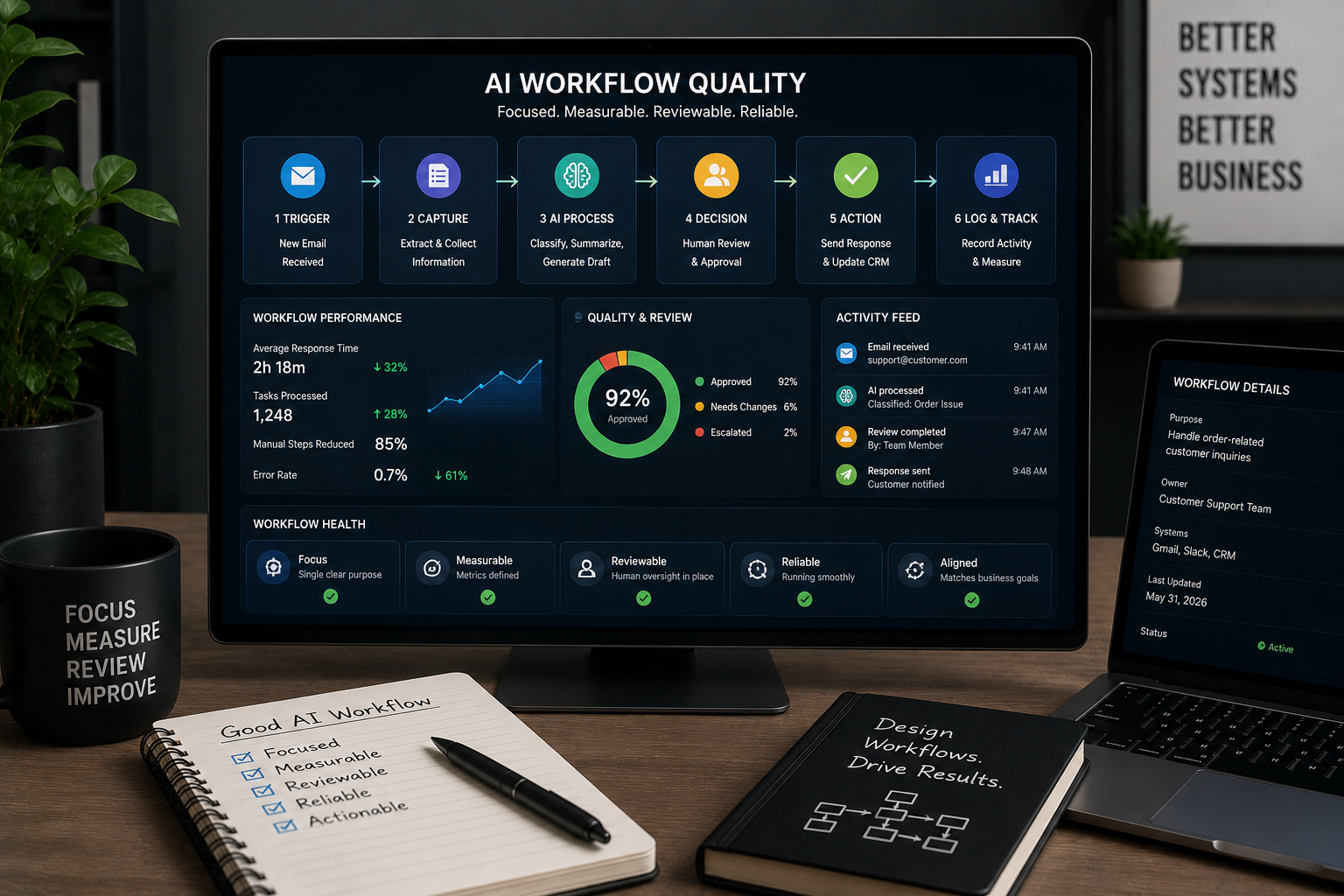
When the workflow is anchored to a real business problem, every part of the system has a reason to exist. The trigger, data, logic, AI step, output, and human review process all serve a measurable operational goal.
Focus Is the First Standard
A weak workflow tries to do too much. It collects too much information, makes too many assumptions, triggers too many actions, and becomes difficult to understand or maintain. A strong workflow is focused. It has a clear start, a clear purpose, and a clear result.
Focus does not mean the workflow is small or simplistic. It means the workflow is designed around one coherent process. For example, “handle customer support” is too broad. “Classify incoming order-related support emails and prepare draft responses for review” is much stronger. The second version has a defined trigger, category, output, and review point.
Focused workflows are easier to test, easier to improve, and easier to trust. They also make it easier to identify whether the automation is actually producing value.
The Workflow Should Be Measurable
If a workflow cannot be measured, it becomes difficult to know whether it is helping the business or simply running in the background. Measurement gives the workflow accountability.
The right metric depends on the purpose of the workflow. A customer support workflow may be measured by response time, number of requests categorized, draft quality, or reduction in missed messages. A reporting workflow may be measured by time saved, report consistency, decision speed, or the number of data sources consolidated. A lead intake workflow may be measured by follow-up speed, qualification accuracy, or conversion opportunities recovered.
The goal is not to turn every workflow into a complicated analytics project. The goal is to define what improvement should look like before the system is built. Without that standard, automation becomes activity instead of leverage.
Good Workflows Preserve Human Review Where It Matters
AI workflows are most effective when they distinguish between coordination and judgment. Coordination is the movement, organization, and preparation of information. Judgment is the decision-making layer that requires context, responsibility, taste, empathy, or strategic interpretation.
A workflow can summarize a customer issue, retrieve order details, classify urgency, and draft a response. But if the issue is sensitive, expensive, emotional, or unusual, a human should review the final decision. The same principle applies to financial communications, legal concerns, brand-sensitive content, hiring decisions, and customer escalations.
Good workflows do not remove human responsibility. They make human responsibility easier to exercise by preparing better context before the person steps in.
The Best Workflows Are Easy to Inspect
Trust is essential in any AI-powered system. A business owner or team should be able to understand what the workflow is doing, why it made a recommendation, where the information came from, and what happened after the workflow ran.
This is why workflow transparency matters. The system should leave a trail: what triggered the workflow, what input was received, what AI produced, what action was taken, and whether a human reviewed or approved the result. Without this visibility, mistakes become harder to diagnose and confidence erodes over time.
A workflow that cannot be inspected is fragile. A workflow that can be reviewed, adjusted, and improved becomes part of the business’s operating infrastructure.
Inputs Need to Be Clean Enough to Trust
AI workflows depend heavily on the quality of the information they receive. If the input is incomplete, inconsistent, or poorly structured, the output will often inherit those weaknesses. This does not mean every business needs perfect data before using automation, but it does mean the workflow should account for input quality.
Strong workflows define what information is required, what information is optional, and what should happen when something is missing. They also create boundaries around what the AI should infer and what it should send to human review.
For example, if a customer message includes an order number, the workflow can retrieve order details and prepare a specific response. If the order number is missing, the workflow may classify the issue but ask the customer for more information. That kind of structure prevents the system from pretending it knows more than it does.
The AI Step Should Have a Clear Role
AI should not be added to a workflow simply because it is available. It should have a defined function. In some workflows, AI may classify information. In others, it may summarize a long message, draft a response, identify themes, compare options, or turn raw data into a readable report.
The clearer the AI role, the better the workflow becomes. A vague AI instruction creates unpredictable output. A precise AI role creates consistency. The workflow should define what the AI receives, what it should produce, what tone or format it should use, and when its output should be reviewed.
This is especially important as workflows become more central to business operations. AI should be treated like a capable assistant with boundaries, not an invisible authority making unchecked decisions.
Reliability Matters More Than Novelty
A good workflow does not need to be flashy. It needs to be reliable. The most valuable automations are often quiet systems that consistently reduce manual work, surface important signals, and help the business operate with fewer missed steps.
Novel workflows may look impressive in a demo, but reliability determines whether the system remains useful after the excitement fades. Can it handle normal variations in input? Can it fail safely? Can a person understand what went wrong? Can it be updated without breaking the entire process?
Reliability is what turns automation from an experiment into infrastructure.
A Good Workflow Fits the Business It Serves
Workflows should be designed around the reality of the business, not an idealized version of how the business should operate. The tools, habits, communication channels, approval processes, customer expectations, and team capacity all matter.
A technically elegant workflow may fail if it requires people to behave in ways they will not sustain. A simpler workflow that fits naturally into existing operations may produce more value because the team actually uses it.
This is why workflow design requires both technical understanding and operational empathy. The best system is not always the most complex one. It is the one that improves the business without creating unnecessary friction.
The Right Workflow Creates Operational Confidence
A good AI workflow should make the business feel more controlled, not more chaotic. It should reduce uncertainty, clarify responsibilities, speed up response, and make important information easier to act on.
When workflows are focused, measurable, reviewable, and designed around meaningful decisions, they become more than automation. They become an operating layer. They help the business convert repeated work into consistent execution.
That is what separates a useful AI workflow from a clever technical setup. A good workflow does not merely perform tasks. It strengthens the way the business thinks, responds, and scales.