Creator Tools Are Becoming Operating Systems
The creator economy has moved far beyond occasional posting and improvised content calendars. Independent creators, small brands, musicians, educators, influencers, and niche media operators are now expected to produce consistently across multiple formats, platforms, and audience segments. A single idea may need to become a short-form video, a carousel, a newsletter, a blog post, a product image, a caption set, a thumbnail, and a campaign concept.
That level of output is difficult to sustain through inspiration alone. Creative work still requires taste, judgment, and originality, but the production environment around that creativity has become increasingly operational. Creators are no longer just making content. They are managing pipelines.
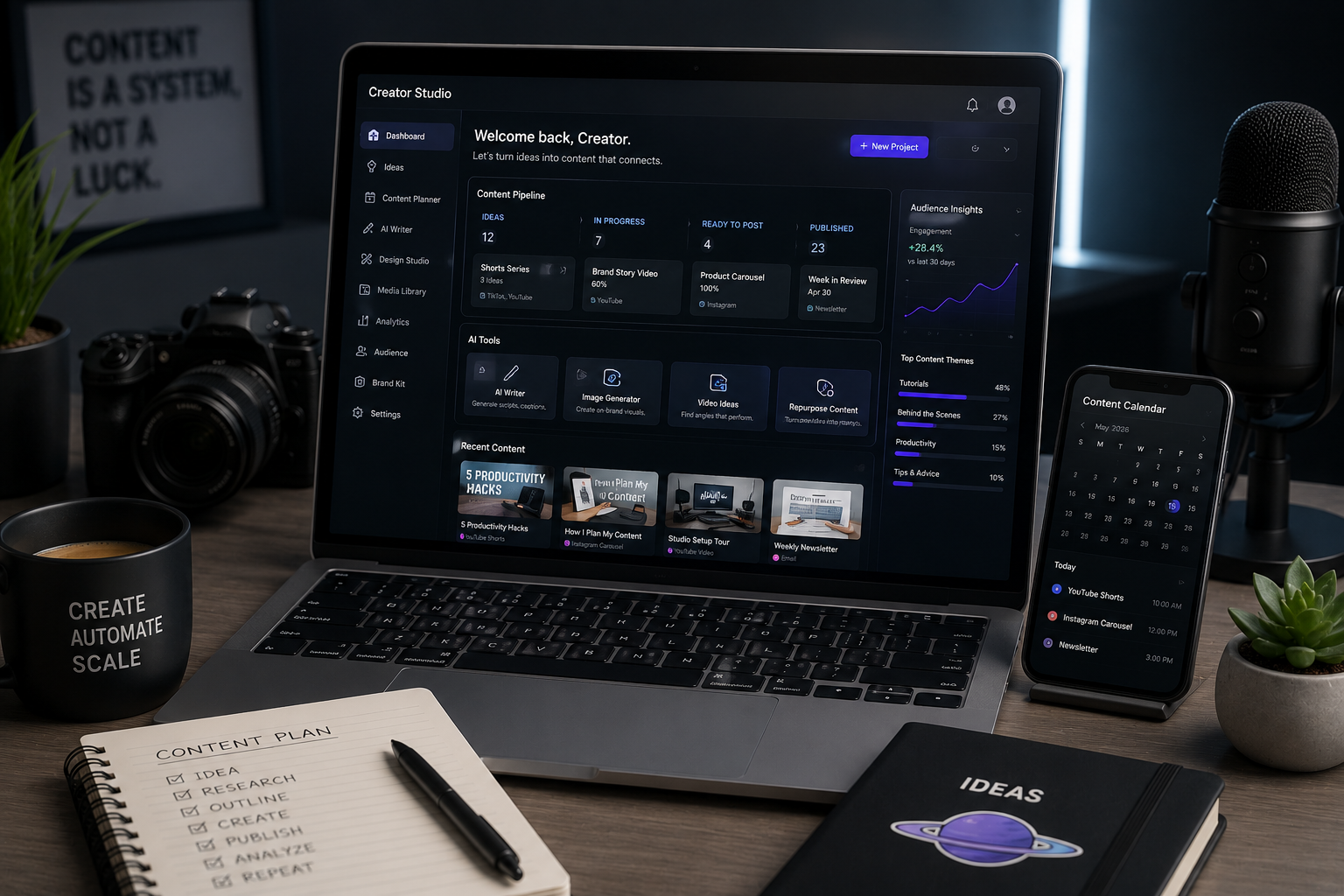
This is why AI creator tools are becoming more important. Their value is not limited to generating images, captions, or scripts. The deeper opportunity is helping creators transform scattered ideas into repeatable systems for planning, production, publishing, analysis, and reuse.
The Real Challenge Is Creative Throughput
Most creators do not lack ideas. They lack the time, structure, and production support required to turn those ideas into finished assets consistently. The gap between concept and publication is where momentum often breaks down.
A creator may have a strong topic but no clear hook. They may have a product but no visual direction. They may have a video idea but no caption strategy. They may have audience data but no organized way to translate that data into better content decisions. Over time, this creates friction. The creator is forced to spend too much energy rebuilding the process from scratch for every post, campaign, or launch.
AI creator tools help reduce that friction by supporting the parts of the creative process that are repetitive, analytical, or structurally predictable.
The most valuable AI creator tools do not replace creative judgment. They create the structure that allows better judgment to move faster.
From One-Off Outputs to Creative Systems
The first wave of AI creator tools focused heavily on individual outputs: generate a caption, produce an image, write a script, summarize a topic, or suggest hashtags. These functions are useful, but they are only the surface layer.
The next stage is more powerful. AI tools are beginning to function as creative systems. They can help define a content angle, develop variations for multiple platforms, organize assets, adapt messaging to different audience segments, and create reusable frameworks for future campaigns.
This changes the role of AI from a simple production assistant into a workflow layer. Instead of asking AI for isolated pieces of content, creators can use AI to build repeatable processes that support the entire content lifecycle.
AI Helps Creators Plan With More Precision
Planning is one of the most underrated parts of content creation. A strong post often begins before the camera turns on, before the image is generated, or before the first line of copy is written. It begins with positioning: who the content is for, what emotional response it should create, what platform it belongs on, and what action it should encourage.
AI tools can help creators clarify those decisions earlier. They can organize rough ideas into content pillars, identify campaign angles, generate structured outlines, and create platform-specific variations. This does not remove the creator’s voice. It helps the creator make strategic decisions before production begins.
For creators managing multiple brands or content lanes, this kind of planning support becomes especially valuable. It reduces the mental load of starting from zero and makes the creative process more consistent.
Production Becomes Faster, But Taste Still Matters
AI has made it easier to generate visual assets, write drafts, create thumbnails, develop scripts, produce mockups, and repurpose existing content. That speed is meaningful, but speed alone does not create quality.
The difference between generic AI content and strong creator-led content is taste. Creators still need to decide what feels authentic, what fits the brand, what should be edited, what should be discarded, and what deserves to be developed further. AI can accelerate production, but human direction determines whether the result has identity.
This is where professional creator tools should be designed carefully. The best systems do not flood creators with random outputs. They help creators produce useful options inside a defined creative direction.
Audience Analysis Becomes More Actionable
Content performance is often measured through scattered signals: views, likes, comments, watch time, saves, shares, email clicks, follower growth, product interest, and customer questions. Each metric can be useful, but the real value comes from interpreting patterns across them.
AI tools can help creators move from raw analytics to practical insight. They can summarize which topics are gaining traction, identify recurring audience questions, compare hooks, organize comments into themes, and suggest content directions based on observed behavior.
This matters because creators do not need more dashboards. They need clearer decisions. The goal is not to stare at more numbers. The goal is to understand what the audience is responding to and how the next round of content should evolve.
Repurposing Becomes a Strategic Advantage
One of the strongest uses of AI creator tools is repurposing. A single strong idea should not live in only one format. It can become a short video, a longer article, a social caption, an email, a carousel, a product description, a voiceover script, a thumbnail concept, or a campaign sequence.
Without systems, repurposing can feel like extra work. With AI-supported workflows, repurposing becomes part of the content engine. The creator can take one core concept and generate structured variations that fit different platforms while preserving the original strategy.
This is especially important for small teams. Repurposing allows creators to increase reach without constantly inventing new ideas from nothing.
The Future Is Not Just Content Generation
The future of AI creator tools is not simply more generated content. The more important shift is toward creator infrastructure. Tools will increasingly help creators store ideas, organize brand assets, generate campaign systems, analyze performance, build reusable prompt frameworks, and coordinate production across multiple formats.
For creators, this means the competitive advantage will not only come from using AI. It will come from building better creative workflows around AI. The strongest creators will be the ones who combine taste, strategy, audience understanding, and repeatable systems.
AI will not make every creator more original. But it can help disciplined creators become more consistent, more efficient, and more capable of turning ideas into assets that serve a larger strategy.
AI Creator Tools Turn Creativity Into a Scalable Process
Creativity still begins with human perspective. The point of AI is not to remove that perspective, but to give it more range. When creators can plan faster, produce with more structure, analyze audience signals, and repurpose ideas intelligently, they gain the ability to operate at a higher level without losing control of their voice.
The rise of AI creator tools marks a shift in how creative work gets managed. The creator is becoming both artist and operator. The tools that matter most will be the ones that respect both roles.
That is where the real opportunity sits: not in replacing creativity, but in building systems that help creative people move with more clarity, consistency, and strategic force.